Tuesday, 1 March 2011

Romanticism: beyond the rational and the birth of the individual.


Romanticism has very little to do with things popularly thought of as "romantic," although love may occasionally be the subject of Romantic art. Rather, it is an international artistic and philosophical movement that redefined the fundamental ways in which people in Western cultures thought about themselves and about their world. 

Casper David Friedrich 'Wanderer above a sea of fog'
 
As an intellectual and aesthetic phenomenon, Romanticism dominated cultural thought from the last decade of the 18th century well into the first decades of the 20th century. From its earliest manifestations in Germany with the "Sturm und Drang" Movement of the 1770's to its vibrant first flowering in England in the 1790's to its importation to American soil from the 1820's onward, Romanticism has exerted a powerful hold on Western thought and culture. 

The Age of Enlightenment, as the 18th century was named for its emphasis on reason and its optimistic faith in a perfectible material and spiritual universe, immolated itself in the flames of the revolutions which closed that century. And as Europe and America arose, phoenix-like from the ashes, a bold new vision had taken hold. The birth of Romanticism is also the birth of the modern. 

The Enlightenment emphasized the primacy of deductive reason, Romanticism emphasized intuition, imagination and feeling. Romanticism focuses on Nature; a place free from society's judgement and restrictions.

 John William Waterhouse 'The Lady of Shallot' 1888

Romanticism, more than anything else, is the cult of the individual - the cultural and psychological nativity of the I - the Self - the inner spark of divinity that links one human being to another and all human beings to the Larger Truth. In poetry, visual art, and music, artists became increasingly preoccupied with articulating the personal experience that becomes, in turn, a representative one. The Poet--the artist in all his various incarnations--takes on quasi-religious status not only as prophet and moral leader, but also as a divinely inspired vehicle through which Nature and the common man find their voices. 

In aesthetic terms this individuality translated into the revolution of feeling against form - the rejection of classical equipoise in favor of Romantic asymmetry. Romantic poets, painters, and musicians ceased struggling to make the expression fit conventional forms and boldly carved out new forms to encase their expression and thought. Ever-striving, ever in flux, the Romantic Soul required an equally dynamic new language to make itself understood.


The image above and the ones below were painted by Casper David Friedrich. The visualisation and portrayal of landscape in an entirely new manner was Friedrich's key innovation. He sought not just to explore the blissful enjoyment of a beautiful view, as in the classic conception, but rather to examine an instant of sublimity, a reunion with the spiritual self through the contemplation of nature. Friedrich was instrumental in transforming landscape in art from a backdrop subordinated to human drama to a self-contained emotive subject. Friedrich's paintings commonly employed the Rückenfigur—a person seen from behind, contemplating the view. The viewer is encouraged to place himself in the position of the Rückenfigur, by which means he experiences the sublime potential of nature, understanding that the scene is as perceived and idealised by a human. 


Friedrich created the notion of a landscape full of romantic feeling. His art details a wide range of geographical features, such as rock coasts, forests, and mountain scenes. He often used the landscape to express religious themes. During his time, most of the best-known paintings were viewed as expressions of a religious mysticism. 


Below it is possible to see how Friedrich's ideas, both compositional and with regards to the concept of the sublime influenced artists in the 20th Century.


Paul Nash


Mark Rothko

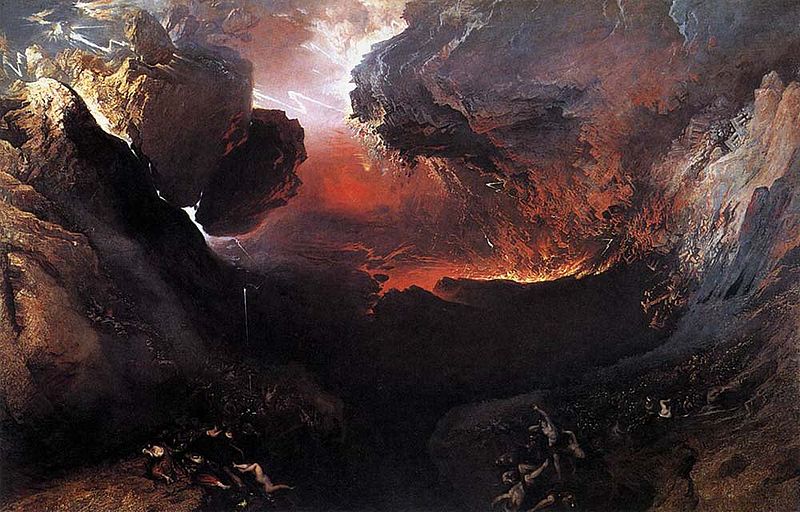
Embracing the unknown and unafraid of the contraries of human existence, the Romantics overthrew the philosophical, artistic - even geographical - limitations of the Enlightenment. The quintessential Romantic figure was the Wanderer, literally and figuratively journeying in search of new lands, new places in the imagination, and new vistas for the soul. Exotic lands, the amorphous world of dreams, the dark terrors of the psyche as well as the dizzying heights of creativity and the dazzling beauties of Nature - these were all waystations along the Romantic quester's route. 

For the Romantic, Nature was, indeed, a constant companion and teacher - both benign and tyrannical. She became the stage on which the human drama was played, the context in which man came to understand his place in the universe, the transforming agent which harmonized the individual soul with what the Transcendentalists would call the Over-Soul. Throughout all of Romantic literature, music, and art, Nature is a dynamic presence, a character who speaks in a language of symbols at once mysterious and anthropomorphic. who engages man in a dialogue with the life-force, itself.


Thomas Cole 'The Voyage of Life' 1842

Still from Lord of the Rings


Glenn Brown 1998

Théodore Géricault 'Raft of the Medusa' 1819

Eugène Delacroix 'Liberty Leading the People' 1830


James Ward 'Gordale Scar' 1814

John Constable 'The Hay Wain' 1821


JW Turner


Joseph Wright 'Cave at Evening' 1774

Henery Fuseli 'The Nightmare' 1781


 William Blake


Realism: The Return to the Real

Realism in the visual arts and literature refers to the general attempt to depict subjects "in accordance with secular, empirical rules", as they are considered to exist in third person objective reality, without embellishment or interpretation. As such, the approach inherently implies a belief that such reality is ontologically independent of man's conceptual schemes, linguistic practices and beliefs, and thus can be known (or knowable) to the artist, who can in turn represent this 'reality' faithfully. Modern realism "begins from the position that truth can be discovered by the individual through the senses" and as such "it has its origins in Descarts and Locke, and received its first full formulation by Thomas Reid in the middle of the eighteenth century."


Realism often refers more specifically to the artistic movement, which began in France in the 1850s. These realists positioned themselves against Romanticism, a genre dominating French literature and artwork in the late 18th and early 19th centuries. Purporting to be undistorted by personal bias, Realism believed in the ideology of objective reality and revolted against the exaggerated emotionalism of the romantic movement. Truth and accuracy became the goals of many Realists. Many paintings which sprung up during the time of realism depicted people at work, as during the 19th century there were many open work places due to the Industrial Revolution and Commercial Revolutions. The popularity of such 'realistic' works grew with the introduction of photography — a new visual source that created a desire for people to produce representations which look “objectively real.”


Courbet painted figurative compositions, landscapes, seascapes, and still lifes. He courted controversy by addressing social issues in his work, and by painting subjects that were considered vulgar, such as the rural bourgeoisie, peasants and working conditions of the poor. His work belonged neither to the predominant Romantic nor Neoclasical schools. History painting, which the Paris Salon esteemed as a painter's highest calling, did not interest Courbet, who stated that "the artists of one century [are] basically incapable of reproducing the aspect of a past or future century" ... Instead, he believed that the only possible source for a living art is the artist's own experience.
His work, along with the work of Jean-François Mille, became known as Realism. For Courbet realism dealt not with the perfection of line and form, but entailed spontaneous and rough handling of paint, suggesting direct observation by the artist while portraying the irregularities in nature. He depicted the harshness in life, and in so doing challenged contemporary academic ideas of art.


Jean-François Millet


John Singer Sargent


Edgar Degas


Thursday, 9 December 2010

Murder, sex, feminism, ego and politics: Western art from the Renaissance to the 19th Century.

The high renaissance was over by the late 16th century, ending with a brief period of idealism and stylised grandeur  that is commonly referred to as mannerism.


Raphael

Michelangelo


Bronzino

Mannerism took the idealised depiction of the human forms, primarily taken from the work of Raphael and Michelangelo as its main inspiration. Mannerism pushed the idea of a perfect, almost cartoonish image the human form as a representation of the scared.

One notable exception in this era was El Greco, a greek painter working under the patronage of the Spanish court, considered by many as the last great painter of the 16th Century. El Greco developed a very distinctive style utilising free brushwork and an expressive, often unreal colour palette. El Greco's aim was the same as the artists of the high renaissance; to arouse religious fervour. But his way of achieving this was completely different from everyone else, making his work look very contemporary.


The world was changing, the Vatican had been battling with the rise of protestantism across Europe in the 30 years war which destroyed its authority. Catholicism was also under attack from the rise of new scientific and philosophical theories, mainly from the newly independent Flemish nations which had broke away from Spanish rule. Spain was weakened by this loss of authority as well as the instability of the Vatican, its closest ally.

The revolution in scientific thought brought Newton's law of gravity by the end of the 17th century and Descarte's philosophical ideas introduced a new skepticism: "I think therefore I am": Undermining conventional theological thought. This great explosion of speculative thinking did not have any immediate effect on the visual arts, but it laid the foundations for a slow revolution eventually taking the visual arts beyond a manual trade under the control of the religious authorities to an intellectual pursuit.

The revolution was stalled by the coincidence of a new Pope re - invigorating the Vatican's power, establishing it as a great artistic centre once more, and limiting the ambitious artists as servants again. Italian art moved towards a notion of naturalism with the painter Caravaggio leading the way. Caravaggio was shocking both in art and real life.


Caravaggio, from Milan, fled to Rome after wounding an officer of the law. He moved from the idealised images of Michelangelo and painted in a more naturalistic style, depicting the human form with all it flaws and detail - he often (as did Michelangelo) find his inspiration and models on the streets of Rome. His interpretations of religious fables were far from angelic, instead depicting violent struggles, decapitations and death.


Caravagios's life imitated his art; he was often involved in fights and fled Rome after killing another man. Whilst in exile a revenge attempt was made on his life which was thought to disfigure his face. He died of an unknown illness shortly afterwards.

Caravaggio developed the technique of chiaroscuro, which used strong contrasts of light and shadow to describe volume and form of the human body. It is his mastery of this technique which makes his work look so familiar and contemporary; it is the language of photography and cinematography. His work became the main influence of a period of art history commonly referred to as the Baroque.

Baroque , Portuguese for deformed pearl, was first used as a critical term of abuse - a deviation from the norm (i.e. the renaissance). It is generally a term that is more easily applied to the ice -cream confection architecture and design popular at the time, but also loosely grouping the artists following and often aesthetically inspired by Caravaggio.

Rubens, a Flemish artist is often described as a Baroque painter and was heavily influenced by Titian (Caravaggio's teacher). Rubens furthered the notion of naturalism, taking it to an extreme and (again) idealised notion of female beauty as a full breasted, broad wasted, more sexual and womanly form in contrast to the girlish, coquetry preferred by the high renaissance. Rubens celebrated and reveled in flesh, sexuality and the female form under the safety of religious art. Rubens, like Caravaggio was interested in the vitality, corporeality of the figure as a way of bringing the super- natural world within the grasp of the human experience.


Jenny Saville

Lucian Freud

Back in Italy, a follower of Caravaggio, Artemisia Gentileschi took violence and chiaroscuro to such an extreme unidealised vision of common humanity that his paintings seemed tame by comparison. Artemsia could be said to be the first feminist artist, working in a time when women had virtually no role in society and often depicting scenes in which women played a dominant role. She was virtually the only woman artist working at the time and was often considered shocking because of her sex and her subject matter. Though Italian, she worked under the patronage of the Spanish court; the Vatican certainly could not deal with the idea of a woman having any kind of voice!


Bernini was an artist who (like Michelangelo) regarded himself as a sculptor primarily, but was also a painter, architect and poet. He dominated the artistic scene in Rome for over half a century, stamping his footprint on the Rome we know today. Bernini brought back the idealised representation of the human form and injected the theatrical qualities of the architecture of the time into his art. He created sculpture with astonishing technical virtuosity, an ability to chisel and rasp white marble into flesh, hair and drapery. He had a hand in the design of St Peters and his sculptures are to be found all across Rome. Often considered his masterpiece, the Ecstasy of St Teresa, is in a small chapel in the outskirts of Rome best demonstrates Bernini's marriage of the idealised form with the Baroque notion of naturalism: St Teresa has often been described as in the throws of physical, erotic abandon. Much like Rubens, Bernini is interested in the depiction of the corporeality as a way of  bringing the super -human to a mass audience. Both could be said to be dealing with the human condition.


Whilst Italian artists were under the patronage of the Vatican, and therefore usually limited to religious motifs, artists under the patronage of the Spanish or Flemish courts were required to create both religious images and portraits of the royalty and upper circles of society.

Diego Velazquez, entered the service of the young Spanish king Philip IV and ended up monopolising the courts' patronage (and Spanish art) for many years. This was in part due to the King taking a strong personal liking to him and Velazquez's own ambition. Velazquez, or rather his ego, played a key part in changing the role of artists in society. He is often cited as one of the greatest painters in the history of western art.


'Las Meninas' is considered to be his masterpiece, changing the way we think about painting and the way artists work. It is essentially, a painting about painting and attempts to elevate the artist beyond the manual tradesman he was considered to be at the time. With Las Meninas painting and the visual arts become an intellectual pursuit.

Velazquez changes the viewpoint and craftily makes himself the subject of what is intended to be a royal portrait. He suggests notions of greatness by placing himself, contemplative and master of his surroundings (which includes the young Infanta - princess) observing the royal subjects. The king and queen become secondary through their absence. The painter and the process of painting becomes more important than the subject. By also placing the viewer in the place of the royal couple he also perhaps begins to question the nature of royal rule and class. It is at this point the revolution really gains ground.


Francis Bacon became obssed by Velazquez's pope innocent x

Rembrandt developed the techniques of Caravaggio, primarily through Biblical scenes. He also painted the great and the good of Dutch society. Rembrandt was constantly painting himself, no other earlier artist had portrayed himself so frequently. He began in the 1620s and went on throughout his life, leaving around a hundred or more self portraits which constitute a unique pictorial autobiography. His intention with this works has often been debated. Most were probably made as studies of character and expression for other works — the rebellious youth, armed knight, in oriental costume...


Cindy Sherman


To a modern audience, Rembrandt seems to be dealing with Freudian notions of identity. A forefather of many contemporary artists.

The 18th Century brought a period of questioning religion, traditional structures of society and a furtherance of democracy often termed 'The Enlightenment'.  By contrast the visual arts developed into a style referred to as Rococo. This style originated in France and was frivolous and often aesthetically over the top. Architecture and design became overtly ornate and painting primarily decorative, often hazy looking using soft textures and pastel colours — though this is often cited as a result of the values of the period; rejecting the academic rules, restrictions and even taste. Taste was considered to be attributable only to the educated, therefore, only they could appreciate the rejection of it. It was a ironic celebration of the kitsch.


Meanwhile, in England the artist William Hogarth grew popular by rejecting the elitist notions of Rococo and making art for the masses. Hogarth created paintings in series which explored narrative moral stories such as the Rake and Harlot's progress which he also released as an edition of prints. Hogarth used contemporary society of the time as his subject; an England where promiscuity, binge drinking and fighting on the street was common place (sound familiar?).


By the end of the Century, Neo-classicism became the predominant style. Neo-classicism was a reaction to Rococo's' sugar coated aesthetic and a return to the values of art of the past. It took its inspiration from the idealised art of  ancient Greece and Rome, the Renaissance and the chiaroscuro of Baroque. The most famous painter of the era was Jacques- Louis-David. David rejected the frivolity of the Rococo and returned to a more serious and moral subject matter of previous eras. The difference was that David and his contemporaries dealt with political issues rather than religious ones; primarily the French revolution.